What Canada’s New PGP Decision Means for Families
For families hoping to bring their parents or grandparents to Canada permanently, July 15, 2026, brought a major immigration update.
Immigration, Refugees and Citizenship Canada (IRCC) has paused new applications under the Parents and Grandparents Program (PGP). New interest-to-sponsor forms will not be accepted, and IRCC will not issue new invitations to potential sponsors until further notice.
There is, however, an important distinction: existing PGP applications will continue to be processed. IRCC also plans to approve up to 15,000 people for permanent residence through the PGP in 2026.
For families that have not yet entered the PGP system, the new policy means parents and grandparents can still come to Canada. The Super Visa remains available, allowing eligible parents and grandparents to stay in Canada for extended periods while the family waits for future immigration instructions.
This article explains what changed, why IRCC made the decision, what the numbers show, and what families can do now.
The July 15, 2026 PGP Announcement
IRCC announced the PGP pause on July 15, 2026.
The current position is straightforward:
| PGP Status | Situation in 2026 |
| New interest-to-sponsor forms | Not accepted |
| New invitations to apply | Not being issued |
| Existing PGP applications | Continue to be processed |
| Planned PGP PR admissions in 2026 | Up to 15,000 |
| Super Visa | Available |
| Program reopening date | Not announced |
IRCC states that interest in the PGP continues to exceed the available spaces under Canada's immigration levels plan. The department is therefore managing intake while continuing work on applications already in its system.
For a family that has already submitted an application, the announcement is very different from the situation faced by someone who has never entered the program.
If you have already submitted a PGP application
The IRCC system continues to process your application.
The July 15 announcement did not cancel existing PGP applications. IRCC has stated that existing files will continue moving through processing.
If you never submitted an interest-to-sponsor form
You cannot submit a new PGP interest form while intake remains paused.
This means that preparing an application today will not secure a spot in the PGP queue. Instead, families should prepare their records and monitor IRCC announcements for future instructions.
Why Did Canada Pause New PGP Intake?
Canada's wider immigration planning closely connects to the answer.
The federal government has set permanent resident admissions at 380,000 per year from 2026 through 2028. Within that overall figure, economic immigration accounts for a larger share of admissions, reaching 64% in 2027 and 2028.
At the same time, Canada is reducing planned temporary resident arrivals.
Canada's 2026–2028 immigration numbers
PERMANENT RESIDENT TARGET
2026 ████████████████████████████████████████ 380,000
2027 ████████████████████████████████████████ 380,000
2028 ████████████████████████████████████████ 380,000
The targets remain stable at 380,000 each year.
Temporary resident arrival targets are lower:
TEMPORARY RESIDENT ARRIVAL TARGET
2026 █████████████████████████████████████ 385,000
2027 ███████████████████████████████████ 370,000
2028 ███████████████████████████████████ 370,000
The plan targets 385,000 temporary resident arrivals in 2026, followed by 370,000 in both 2027 and 2028.
This wider policy direction places more emphasis on people already living in Canada, labour-market needs, and controlled immigration levels.
The PGP Pause Is About Intake Capacity
It is easy to read the announcement about Canada abandoning parent and grandparent reunification.
That is not what IRCC announced.
Family reunification remains part of Canada's immigration framework. The government has simply stopped accepting new PGP interest forms while continuing to process existing applications.
The numbers make the situation clearer.
IRCC plans to approve up to 15,000 people through the PGP in 2026, despite the new intake pause.
PGP in 2026
| Measure | Number |
| New interest forms | 0 accepted |
| New invitations | 0 issued |
| Planned PGP PR admissions | Up to 15,000 |
| Existing applications | Continue processing |
So, there is a difference between pausing new intake and stopping the program altogether.
The former is what IRCC has announced.
What the Immigration Levels Plan Tells Us
The PGP decision makes more sense when viewed alongside the wider 2026–2028 plan.
Canada has allocated permanent resident admissions across several major categories.
2026 planned permanent resident admissions
| Category | 2026 Target |
| Economic | 239,800 |
| Family Reunification | 84,000 |
| Refugees, Protected Persons, Humanitarian & Other | 56,200 |
| Total | 380,000 |
These figures come from Canada's published immigration planning documents.
Family reunification therefore remains part of the overall immigration plan.
The PGP is just one part of the family category, and spots for parents and grandparents are limited.
That creates a situation where demand can exceed the number of spaces available.
What This Policy Means for Parents and Grandparents
The practical impact depends on your current position.
Scenario 1: You Already Have an Application in Process
If your PGP application was submitted before the pause, the July 15 announcement does not mean you need to start again.
IRCC says existing applications will continue to be processed.
Your focus should be on keeping your contact details current, responding to IRCC requests, and checking the status of your application.
Do not submit duplicate applications simply because you have seen news about the pause.
Scenario 2: You Were Hoping to Apply in 2026
If you had planned to enter the PGP but had not submitted an interest-to-sponsor form, you cannot enter the program while intake is paused.
This situation is where preparation matters.
You can begin organizing:
- Notices of Assessment
- CRA income records
- Employment records
- Passport information
- Marriage and birth certificates
- Proof of family relationship
- Previous Canadian visa information
- Travel history
- Previous refusal letters, if applicable
- Family composition information
Having these records organized does not guarantee admission to a future PGP intake. It simply means you are not starting from zero if IRCC announces another intake.
The Super Visa Becomes More Important
For families who want their parents or grandparents to spend substantial time in Canada, the Super Visa is now an important option to examine.
IRCC states that a Super Visa can allow parents and grandparents to visit their children or grandchildren in Canada for up to five years at a time, with multiple entries for up to 10 years.
Parents and grandparents visiting under the Super Visa can also apply for extensions of their stay while in Canada, subject to the applicable rules.
The Super Visa is not permanent residence.
That distinction matters.
PGP vs. Super Visa
| Feature | PGP | Super Visa |
| Immigration status | Permanent residence | Temporary resident |
| New applications in July 2026 | Paused | Available |
| Parents/grandparents can visit Canada | Yes | Yes |
| Extended stays | Not applicable | Up to 5 years at a time |
| Multiple entries | PR status | Visa can allow multiple entries |
| Permanent residence | Yes | No |
| Main purpose | Permanent family reunification | Extended family visits |
The two programs solve different problems. A Super Visa can provide a route for extended family visits, while a PGP is intended to provide permanent residence.

The rules for the Super Visa were also changed in 2026.
Canada introduced updated Super Visa income instructions effective March 31, 2026.
The updated rules changed how the host's income can be assessed. In certain circumstances, the income of the parent or grandparent applying for the Super Visa can also be included in the calculation, provided the applicable conditions are met.
The host must generally:
- Be at least 18 years old
- Be a Canadian citizen, permanent resident, or registered Indian
- Live in Canada
- Meet the applicable minimum income requirement
- Provide a signed invitation
- Demonstrate the family relationship
- Provide the required health insurance
- Meet the other Super Visa requirements
IRCC's 2026 instructions also specify health insurance requirements and medical examination requirements.
Because income rules can depend on family size and the applicant's circumstances, families should review the current IRCC rules before filing.
A Simple Family Decision Chart
If you are unsure which direction applies to your family, start here:
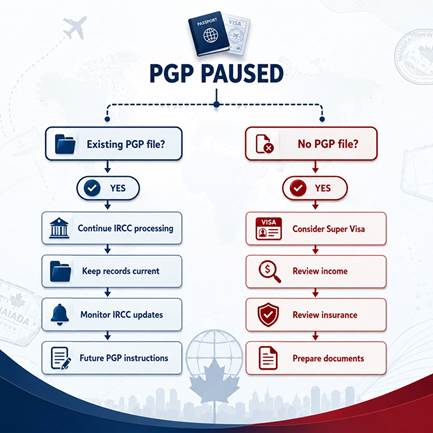
This does not replace an eligibility assessment, but it shows why your next step depends heavily on your current immigration position.
Canada's Shift Toward People Already in the Country
The PGP pause is also part of a larger policy direction.
Canada's 2026–2028 plan includes initiatives aimed at transitioning people already in Canada toward permanent residence.
For example, the government announced a one-time initiative involving approximately 115,000 protected individuals and their in-Canada dependents over 2026 and 2027.
There is also an initiative targeting up to 33,000 temporary workers for transition to permanent residence over 2026 and 2027.
The figures show the scale of this shift:
| Initiative | Approx. Number |
| PGP PR admissions planned for 2026 | Up to 15,000 |
| Protected persons initiative | Up to 115,000 |
| Temporary workers initiative | Up to 33,000 |
| Annual PR target | 380,000 |
| Economic share by 2027–28 | 64% |
The 115,000 figure should not be confused with PGP admissions. It relates to a separate initiative for protected individuals and their in-Canada dependents.
What Families Should Do While Waiting
A pause can create uncertainty, but there are practical steps families can take now.
1. Check Your Current Immigration Position
Start with the basics.
Are you:
- A Canadian citizen?
- A permanent resident?
- Living in Canada?
- Currently sponsoring another family member?
- Already involved in a PGP application?
- Planning to bring parents temporarily rather than permanently?
These details can change which options are available.
2. Review Your Income Records
Income documentation is important for both sponsorship planning and Super Visa applications.
Keep copies of relevant CRA records, including Notices of Assessment.
For future PGP planning, maintaining a consistent record can make document preparation easier if IRCC announces a new intake.
For Super Visa applications, the current income rules should be checked against the family's size and circumstances.
3. Organize Family Documents
Create one secure folder containing:
Sponsor documents
- Passport or citizenship document
- PR card, where applicable
- CRA records
- Employment documents
- Address history
- Family information
Parent or grandparent documents
- Passport
- Birth certificate
- Marriage documents
- Travel history
- Previous visa decisions
- Medical information requested by IRCC
The exact documents required depend on the pathway and application instructions in force when you apply.
4. Review the Super Visa Option
If the immediate goal is to have parents or grandparents spend significant time with family in Canada, check whether the Super Visa fits the situation.
It may provide a temporary route while the PGP remains closed to new intake.
But remember: a Super Visa does not convert into permanent residence automatically.
5. Monitor IRCC Announcements
The most important information will come directly from IRCC.
The department has not announced a date for reopening PGP intake.
Do not trust social media posts that claim applications have reopened unless an official IRCC announcement verifies the information.
Immigration rules can change quickly, and outdated information can lead to unnecessary fees or missed deadlines.
Here is what Travia Immigration and Consultancy can do for you.
At Travia Immigration and Consultancy, we can help families assess their position in light of the 2026 PGP pause.
Our role can include reviewing:
- Current Canadian status
- Family relationships
- PGP history
- Income records
- Super Visa eligibility
- Previous visa refusals
- Parent or grandparent travel history
- Documentation
- Other immigration pathways that may apply
The goal is to establish what can be done now, what should be prepared for a future PGP intake, and which temporary option may fit the family's circumstances.
For families with existing applications, document and status reviews can help identify whether any IRCC request requires action.
For families without a PGP application, the focus can shift toward preparation and alternative pathways rather than simply waiting.
Frequently Asked Questions
Is the Parents and Grandparents Program permanently closed?
No. IRCC has announced a pause in new PGP intake, not permanent cancellation. New interest-to-sponsor forms and invitations are paused until further notice. Existing applications continue to be processed.
Can I submit a new PGP application in August 2026?
No. IRCC is not currently accepting new interest-to-sponsor forms or issuing new invitations.
How many PGP applicants will Canada approve in 2026?
IRCC plans to approve up to 15,000 people for permanent residence through the PGP in 2026.
Can my parents still come to Canada?
Potentially, yes. Eligible parents and grandparents may be able to apply for a Super Visa, subject to IRCC requirements.
How long can parents stay under a Super Visa?
A Super Visa can permit stays of up to five years at a time, with multiple entries for up to 10 years.
Does a Super Visa give permanent residence?
No. It is a temporary resident visa. PGP, when available and approved, provides permanent residence.
When will PGP applications reopen?
IRCC has not announced a reopening date. Families should monitor official IRCC announcements for changes.
The Bottom Line for Canadian Families in 2026
The July 2026 PGP pause changes the immediate route for families who had planned to sponsor parents or grandparents.
But it does not eliminate family reunification from Canada's immigration framework.
The current picture is:
15,000 planned PGP permanent resident admissions in 2026.
380,000 planned permanent resident admissions annually from 2026 through 2028.
64% economic immigration share by 2027 and 2028.
115,000 protected individuals targeted through a separate 2026–2027 initiative.
33,000 temporary workers targeted through another 2026–2027 initiative.
5 years of potential stay at a time under the Super Visa.
10 years of potential multiple-entry validity for the Super Visa.
The message for families is simple: do not assume that the PGP pause means there are no options.
If you already have a PGP application, please continue to monitor its progress. If you have not entered the program, please review the Super Visa and prepare your records for any future PGP intake.
Immigration policies can change, and eligibility depends on individual circumstances. Before taking action, review the current IRCC requirements and consider speaking with a regulated Canadian immigration professional.
Address: 31 Baldwin St N #132, Whitby, ON L1M 0A7, Canada
Phone: +1 905-924-6565
Travia Immigration and Consultancy can help you review your situation and identify the immigration steps that may apply to your family in 2026.