
What the 2026 TFWP Changes Mean for Employers and Foreign Workers
Canada’s Temporary Foreign Worker Program (TFWP) has entered another phase of policy changes in 2026. Employers hiring workers from outside Canada now face revised wage thresholds, tighter rules for low-wage Labour Market Impact Assessment (LMIA) applications, expanded recruitment obligations, regional restrictions, and temporary measures for some rural employers.
For employers and foreign workers, the date, work location, occupation, wage, and type of LMIA can now have a major impact on whether an application can move forward.
The most recent wage update applies to LMIA applications received on or after July 17, 2026. At the same time, Employment and Social Development Canada (ESDC) continues to apply a separate unemployment-based refusal-to-process measure for certain low-wage positions in census metropolitan areas (CMAs) where unemployment is at least 6%. The current unemployment table applies from July 10 through October 8, 2026, with another update scheduled for October 9.
For employers planning to hire through the TFWP, these changes make preparation and timing increasingly important.
TFWP Rules in 2026 at a Glance
Here are the main points employers and foreign workers should know:
| Change | 2026 rule |
| New wage thresholds | July 17, 2026 |
| Low-wage CMA unemployment test | 6% or higher |
| Current CMA table | July 10–October 8, 2026 |
| Next CMA update | October 9, 2026 |
| Low-wage advertising period | 8 consecutive weeks |
| Youth recruitment | Ages 15–30 |
| Standard low-wage workforce cap | 10% |
| Certain sector cap | 20% |
| Rural temporary measures | April 1, 2026–March 31, 2027 |
| Low-wage work authorization under current TFWP framework | Generally up to 1 year |
The federal government states that wage thresholds determine whether an LMIA application belongs in the high-wage or low-wage stream. The threshold itself is calculated using the provincial or territorial median hourly wage plus 20%.
July 17, 2026: Wage Threshold Changes
One of the most important TFWP changes this year is the annual adjustment to the hourly wage thresholds.
These thresholds are not minimum wages.
Instead, they are used to determine which LMIA stream an employer must use.
If the wage for the position is at or above the applicable provincial or territorial threshold, the employer generally applies through the high-wage stream.
If the wage is below that threshold, the employer generally applies through the low-wage stream.
2026 Wage Threshold Table
| Province or Territory | Previous Threshold | From July 17, 2026 | Increase |
| Alberta | $36.00 | $37.50 | $1.50 |
| British Columbia | $36.60 | $38.40 | $1.80 |
| Manitoba | $30.16 | $31.33 | $1.17 |
| New Brunswick | $30.00 | $31.73 | $1.73 |
| Newfoundland and Labrador | $32.40 | $33.60 | $1.20 |
| Northwest Territories | $48.00 | $48.00 | $0.00 |
| Nova Scotia | $30.00 | $31.96 | $1.96 |
| Nunavut | $42.00 | $45.00 | $3.00 |
| Ontario | $36.00 | $36.92 | $0.92 |
| Prince Edward Island | $30.00 | $31.20 | $1.20 |
| Quebec | $34.62 | $36.00 | $1.38 |
| Saskatchewan | $33.60 | $34.62 | $1.02 |
| Yukon | $44.40 | $45.60 | $1.20 |
Source: Government of Canada, hourly wage threshold table updated July 2026.

Which Provinces Saw the Largest Changes?
The figures indicate that the threshold increased in 12 of the 13 jurisdictions.
Nunavut recorded the largest dollar increase, moving from $42.00 to $45.00 per hour, a $3.00 increase.
Nova Scotia moved from $30.00 to $31.96, while British Columbia moved from $36.60 to $38.40.
The Northwest Territories remained unchanged at $48.00.
Wage Threshold Increase
Nunavut +$3.00 ████████████████████
Nova Scotia +$1.96 █████████████
British Columbia +$1.80 ████████████
New Brunswick +$1.73 ███████████
Alberta +$1.50 ██████████
Quebec +$1.38 █████████
NFLD & Labrador +$1.20 ████████
PEI +$1.20 ████████
Yukon +$1.20 ████████
Manitoba +$1.17 ████████
Saskatchewan +$1.02 ███████
Ontario +$0.92 ██████
Northwest Territories +$0.00
The key point is that an employer should not compare the wage only with the general provincial minimum wage. The LMIA stream requires a separate threshold and a prevailing wage assessment.
The Threshold Is Not the Same as the Prevailing Wage
This distinction is important for employers.
The provincial or territorial threshold answers one question:
Does the position fall under the high-wage or low-wage LMIA stream?
The prevailing wage answers another:
Is the wage appropriate for the occupation, location, and comparable workers?
The Government of Canada states that the wage for a temporary foreign worker should be consistent with the prevailing wage. This generally involves comparing the Job Bank median wage with the wages paid to Canadian citizens and permanent residents working in the same occupation and location with similar skills and years of experience.
For example, consider an Ontario position paying $36.00 per hour.
Ontario’s July 2026 threshold is $36.92.
Because $36.00 is below $36.92, the position would generally fall under the low-wage stream.
However, simply increasing the wage to $36.92 does not automatically solve the issue. The employer must still meet the prevailing wage requirements. The federal government specifically warns that artificially changing wages to fit a program stream can lead to a negative LMIA decision.
Why the LMIA Submission Date Matters
The wage threshold is connected to the date ESDC receives the LMIA application.
This creates an important distinction between:
- when an employer starts recruiting;
- when a job advertisement is published;
- when documents are prepared; and
- when the LMIA application is received.
For applications received on or after July 17, 2026, the new wage threshold table applies.
An employer preparing an LMIA should therefore verify the current table immediately before submission rather than relying on an older wage chart.
Low-Wage LMIA Restrictions in High-Unemployment CMAs
The wage threshold is only one part of the assessment.
A separate rule applies to certain low-wage positions located in CMAs with unemployment at or above 6%.
When a position is below the applicable provincial or territorial wage threshold and the work location falls within a CMA that meets the 6% unemployment test, the LMIA application may be refused for processing unless an exemption applies.
This means two employers in different Canadian cities can face different outcomes even when they have:
- the same occupation;
- the same wage;
- the same business type; and
- the same recruitment plan.
Location now plays a major role.
Current CMA Unemployment Rates
The current table applies to applications submitted from July 10, 2026, through October 8, 2026.
Some of the affected CMAs include:
| Province | CMA | Unemployment Rate |
| Newfoundland and Labrador | St. John’s | 7.3% |
| New Brunswick | Moncton | 8.1% |
| Quebec | Montréal | 6.8% |
| Ontario/Quebec | Ottawa-Gatineau | 6.7% |
| Ontario | Belleville-Quinte West | 6.7% |
| Ontario | Peterborough | 7.0% |
| Ontario | Oshawa | 8.5% |
| Ontario | Toronto | 7.3% |
| Ontario | Hamilton | 6.9% |
| Ontario | Kitchener-Cambridge-Waterloo | 8.1% |
| Ontario | Brantford | 6.2% |
| Ontario | Guelph | 7.4% |
| Ontario | London | 7.8% |
| Ontario | Windsor | 7.9% |
| Ontario | Barrie | 7.9% |
| Ontario | Greater Sudbury | 6.2% |
| Saskatchewan | Saskatoon | 6.5% |
| Alberta | Calgary | 7.0% |
| Alberta | Red Deer | 7.2% |
| Alberta | Edmonton | 7.2% |
| British Columbia | Kelowna | 7.5% |
| British Columbia | Kamloops | 7.0% |
| British Columbia | Chilliwack | 7.9% |
| British Columbia | Abbotsford-Mission | 8.0% |
| British Columbia | Vancouver | 6.7% |
| British Columbia | Nanaimo | 6.5% |
Source: Government of Canada unemployment table for July 10–October 8, 2026.
A Simple Way to Read the Rule
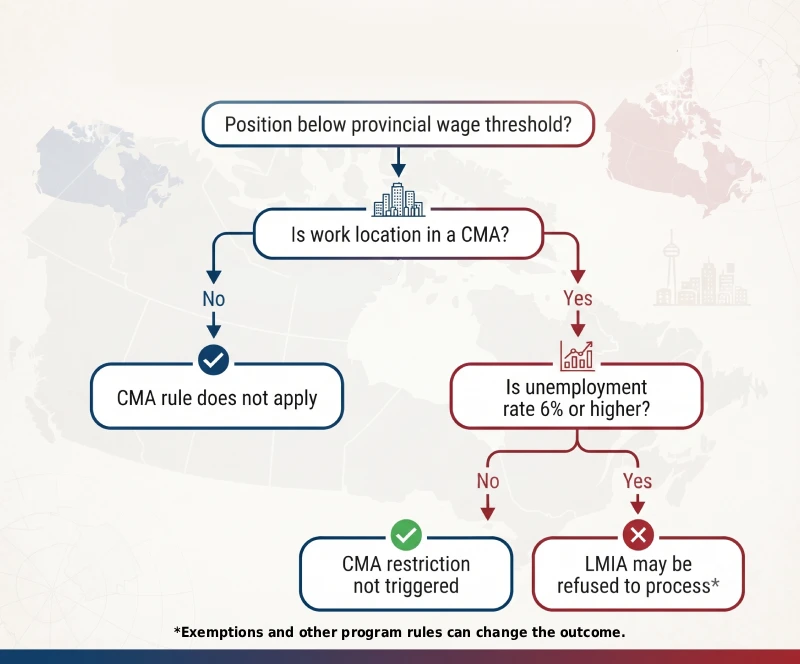
Employers should verify the work location using the full postal code. A location classified as a census agglomeration rather than a CMA is not subject to this particular 6% CMA refusal-to-process rule.
Some Cities Enter and Leave the Restricted Group
The CMA table changes every three months.
That means an area can move into or out of the restriction as labour market data changes.
For the current July 2026 period, examples of areas that moved above the 6% line include:
- Saskatoon
- Red Deer
- Kamloops
- Chilliwack
Other CMAs moved below 6%, including Halifax, Saint John, Fredericton, Drummondville, Kingston, St. Catharines-Niagara, Winnipeg, and Regina.
This situation matters because the same occupation and employer may face different LMIA processing conditions in another three-month period.
The next unemployment table is scheduled for October 9, 2026.
This Is Not a Cancellation of Existing Work Permits
The CMA rule is a refusal-to-process measure for certain LMIA applications.
It does not mean that every temporary foreign worker already in Canada loses their work permit when a city reaches the 6% unemployment level.
The LMIA process and work permit process are separate.
ESDC assesses the LMIA, while Immigration, Refugees and Citizenship Canada (IRCC) assesses the work permit application.
A worker with an existing employer-specific work permit does not automatically lose that authorization simply because:
- the provincial wage threshold changes;
- the local unemployment rate rises;
- the position becomes classified under the low-wage stream.
The issue becomes more important when the worker needs a new LMIA for an extension, a new employer, or another employer-specific work permit.
Low-Wage LMIA Applications Now Require Eight Weeks of Advertising
Recruitment requirements have also changed.
For low-wage LMIA applications, employers must advertise the position for at least eight consecutive weeks within the three months before submitting their application.
That represents a major change from the previous four-week general minimum.
The federal government has also stated that at least one required recruitment activity must remain active until Service Canada reaches a decision.
Recruitment Timeline
Week 1 ─── Recruitment begins
Week 2 ─── Advertising continues
Week 3 ─── Candidate search
Week 4 ─── Previous minimum reached
Week 5 ─── Recruitment continues
Week 6 ─── Recruitment continues
Week 7 ─── Recruitment continues
Week 8 ─── Eight-week requirement reached
│
▼
LMIA submission
The process can affect hiring timelines significantly.
An employer that discovers a labour shortage today cannot necessarily advertise for four weeks and immediately submit a low-wage LMIA.
The recruitment record needs to demonstrate that the required steps were completed.
Youth Recruitment Is Now Part of the Low-Wage Process
Another change introduced in 2026 requires employers applying for low-wage LMIAs to demonstrate efforts to recruit youth between 15 and 30 years of age.
Possible recruitment channels can include youth-focused employment platforms, educational institutions, youth employment programs, community organizations, and other appropriate channels.
The goal is to demonstrate that the employer considered Canadian workers, including younger job seekers, before seeking a temporary foreign worker.
For Job Bank recruitment, employers must also follow the applicable requirements concerning matched candidates and Direct Apply applications.
Recruitment Evidence Employers Should Keep
A strong recruitment file can include:
| Record | Why it matters |
| Job advertisement | Shows position details |
| Posting dates | Establishes recruitment duration |
| Screenshots | Preserves online evidence |
| Candidate applications | Shows domestic response |
| Candidate correspondence | Records follow-up |
| Job Bank records | Documents federal recruitment |
| Youth recruitment records | Shows youth outreach |
| Interview notes | Records candidate assessment |
| Hiring results | Shows recruitment outcome |
Keeping these records can make the employer’s LMIA file easier to review.
The Low-Wage Workforce Cap Still Matters
The TFWP also limits the proportion of low-wage temporary foreign workers at a work location.
The standard cap is generally 10% of the employer’s workforce at the location.
Certain sectors have a 20% cap, including:
- construction;
- food manufacturing;
- hospitals;
- nursing and residential care facilities; and
- certain in-home caregiver positions.
The federal government continues to apply these sector-specific variations.
Workforce Cap Comparison
Standard sectors 10% ██████████
Specified sectors 20% ████████████████████
Employers should calculate the workforce percentage using the applicable TFWP rules rather than assuming that an entire industry automatically qualifies for the 20% level.
Rural Employers Have Temporary Measures
Some employers face looser restrictions.
The federal government introduced temporary measures for eligible rural employers from April 1, 2026, through March 31, 2027.
For this program, "rural" generally means a work location outside a CMA.
Depending on the province or territory and the measure available there, eligible employers may be permitted to retain their existing proportion of low-wage temporary foreign workers above the normal cap and, in some jurisdictions, use a 15% cap instead of 10%.
Rural Participation Snapshot
| Province/Territory | Current federal rural measure |
| Alberta | Not participating |
| British Columbia | Existing above-cap proportion may be retained |
| Manitoba | 15% cap |
| Northwest Territories | Existing proportion may be retained + 15% cap |
| Nova Scotia | Existing proportion may be retained + 15% cap |
| Nunavut | Not participating |
| Ontario | Not participating |
| PEI | To be determined |
| Quebec | Existing above-cap proportion may be retained |
| Saskatchewan | To be determined |
| Yukon | To be determined |
The federal page states that implementation varies by jurisdiction and that the measures apply after an eligible employer submits a new LMIA during the applicable period.
Why Rural Status Matters
An employer should not determine rural eligibility simply by looking at the town name.
The federal definition is tied to Statistics Canada geography.
A worksite outside a CMA may qualify as rural for the temporary measure, while another worksite in the same broad region may not.
Postal code and census geography, therefore, matter.
Quebec Has Additional TFWP Considerations
Quebec employers need to consider federal TFWP requirements along with Quebec-specific rules.
The Montréal and Laval regions have additional restrictions for certain low-wage LMIA applications.
The federal refusal-to-process page continues to identify certain low-wage positions in the economic regions of Montréal and Laval as among the categories subject to refusal-to-process measures.
Quebec also maintains its occupation list for facilitated LMIA processing.
Employers using that route should verify the current 2026 occupation list before filing rather than relying on a previous year's list.
Because Montréal is currently above the 6% unemployment threshold, employers in that area should check both the national CMA rule and Quebec-specific restrictions before proceeding.
What These Changes Mean for Canadian Employers
The 2026 TFWP framework establishes several checkpoints for employers before filing an LMIA application.
A business should first identify the exact occupation and NOC code.
Next, it should establish the work location and postal code.
The wage should then be compared against both:
- the provincial or territorial LMIA stream threshold; and
- the applicable prevailing wage.
Thereafter, the employer should determine whether the position falls under the low-wage stream and whether any CMA restriction applies.
If it does, the employer needs to check for an exemption.
For low-wage applications, recruitment should also be reviewed against the eight-week advertising requirement and youth recruitment requirement.
Finally, the employer should calculate the applicable low-wage workforce cap.
Employer LMIA Decision Path
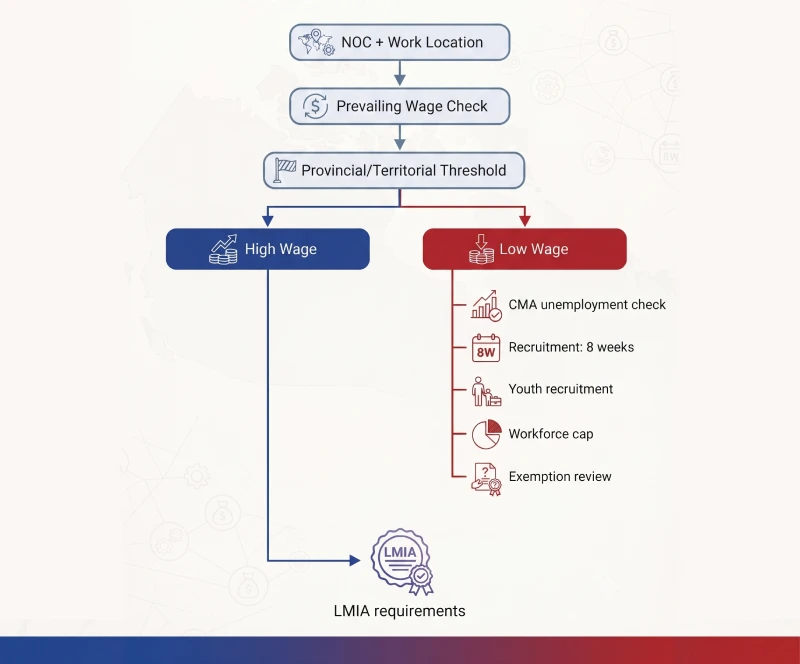
This sequence shows why the wage alone does not determine whether an LMIA will succeed.
What These Changes Mean for Temporary Foreign Workers
Foreign workers should also pay attention to these changes, particularly when their current status depends on an employer-specific LMIA.
A new wage threshold does not automatically change the wage printed in an existing employment arrangement.
Likewise, a worker does not automatically lose their current work authorization because a city enters the 6% unemployment group.
The impact becomes more direct when the worker needs a new LMIA-supported application.
This situation can arise when a worker is seeking:
- an extension of an employer-specific work permit;
- a new employer-specific work permit;
- continued employment after current authorization expires; or
- a new LMIA-supported position.
If an employer cannot obtain the required LMIA, the worker may need to examine another work permit category, an LMIA-exempt route, or a permanent residence pathway, depending on their circumstances.
A foreign worker should also remember that applying for an LMIA does not itself authorize work for a new employer.
A Practical 2026 LMIA Checklist for Employers
Before submitting an LMIA application, employers should review the following:
- Confirm the correct NOC code.
- Confirm the actual work location and postal code.
- Verify the current Job Bank median wage.
- Compare the wage with the provincial or territorial threshold.
- Determine whether the position falls into the high-wage or low-wage stream.
- Verify whether the worksite is inside a CMA.
- Determine the unemployment rate for the applicable three-month period.
- Review all refusal-to-process exemptions.
- Calculate the applicable low-wage workforce cap.
- Complete at least eight consecutive weeks of required low-wage advertising.
- Complete the required youth recruitment activity.
- Keep records of recruitment and candidate responses.
- Verify whether rural measures apply.
- Review provincial or territorial requirements.
- For Quebec, review the additional rules.
- Confirm that all information remains accurate immediately before submission.
Three Numbers Employers Should Watch in 2026
Three figures now deserve particular attention when preparing a low-wage LMIA.
1. 20%
The provincial or territorial median hourly wage is increased by 20% to calculate the LMIA stream threshold.
2. 6%
A low-wage position located in a CMA with unemployment at or above 6% can fall under the refusal-to-process measure unless an exemption applies.
3. 8 Weeks
Low-wage positions require eight consecutive weeks of advertising before an LMIA application is submitted.
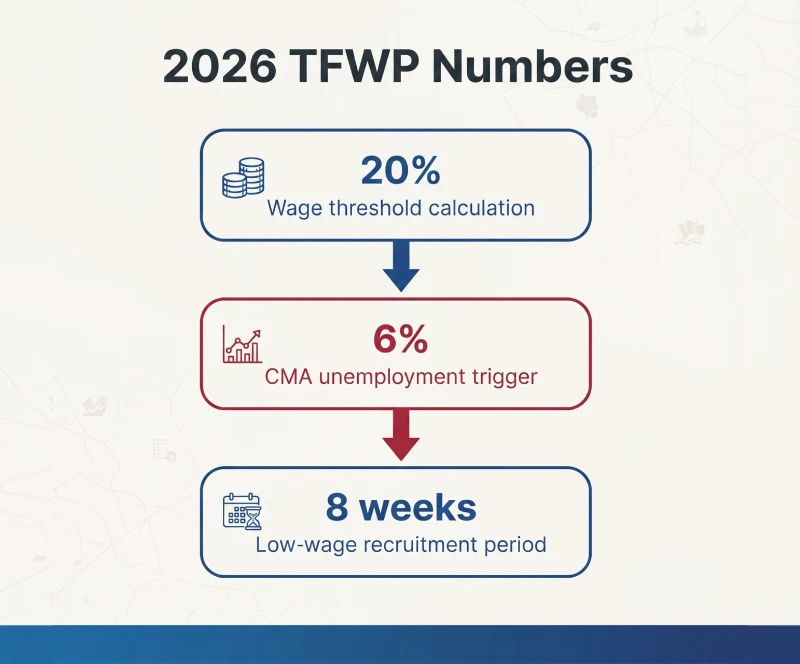
These numbers do not replace the full TFWP rules, but they provide a quick starting point for an employer reviewing a potential LMIA.
Why Timing Matters More in 2026
The TFWP is increasingly dependent on dates.
A wage threshold can change annually.
A CMA unemployment rate can change every three months.
A rural measure has a fixed temporary period.
Recruitment for low-wage positions now requires eight consecutive weeks.
This creates a moving compliance timeline.
For example, an employer preparing an application in early October 2026 should not automatically rely on the July CMA unemployment table. The current table applies through October 8, while another update is scheduled for October 9.
A difference in submission date can therefore change the assessment framework.
Compliance Is Also Receiving Greater Attention
The federal government has reported increased enforcement activity under the TFWP.
Between April 1, 2025, and March 31, 2026, ESDC finalized 1,488 compliance inspections. According to the Government of Canada, 12% of inspected employers were found non-compliant, more than $10.2 million in monetary penalties were issued, and 30 employers were banned from accessing the program.
This is important because LMIA approval is only one part of an employer's responsibilities.
Employers must continue meeting the conditions attached to the TFWP after a worker is hired.
That includes compliance with wages, working conditions, recruitment representations, and other program obligations.
What Employers Should Do Next
The 2026 TFWP framework mandates that employers consider all aspects, not just the wage.
Before starting an LMIA application, review:
Occupation → NOC → Work Location → Wage → Stream → CMA Status → Recruitment → Workforce Cap → Exemptions → Submission Date
This sequence can help identify issues before an application is filed.
For foreign workers, the key question is different:
Does the employer still qualify to support the required LMIA and work permit route under the rules in force when the application is submitted?
That question becomes especially important for workers approaching the expiry of an employer-specific work permit.
Moving Forward
Canada's TFWP rules have shifted significantly during 2026, particularly for low-wage positions.
The July 17 wage threshold update changed the dividing line between the high-wage and low-wage streams across most provinces and territories. At the same time, the 6% CMA unemployment rule continues to restrict certain low-wage LMIA applications in urban labour markets.
Low-wage employers also need to account for the eight-week recruitment period, youth recruitment requirements, and the applicable workforce cap.
Rural employers may have access to temporary measures, but participation varies by province or territory, and eligibility depends on the location and other program conditions.
For Quebec, additional federal and provincial considerations can apply.
The next major CMA unemployment update is scheduled for October 9, 2026, making the submission date an important factor for employers preparing applications around that period.
At Travia Immigration and Consultancy, we can help employers and foreign workers review how the current TFWP and LMIA rules relate to their circumstances. Because requirements can change according to occupation, wage, location, recruitment history, and submission date, checking the current federal rules before filing is important.
Address: 31 Baldwin St N #132, Whitby, ON L1M 0A7, Canada
Phone: +1 905-924-6565
For the latest Canadian immigration information and help with your LMIA or work permit plans, contact Travia Immigration and Consultancy.